MIG Welding GCD-level Options
The MIG Welding operation provides the following options, which can be set on a per-GCD basis:
Weld Cycle Time Method
Welding arc time (see the formula for Weld Time in MIG Welding Operation Weld Time) is determined in one of two ways:
-
Volumetric Rate Method: based on the following:
-
Weld Volume
-
Deposition rate (derived from the machine properties Wire Feed Rate and Wire Diameter)
-
-
Linear Rate Method: based on the following:
-
Weld length
-
Travel Speed (derived from Weld Throat and Filler Material Type, or specified by the user)
-
See the formulas for Volume Method Arc Time Calculated and Length Method Arc Time Calculated in MIG Welding Operation Weld Time.
Filler Material Type
By default in starting point Digital Factories, the weld is assumed to use steel filler. Administrators can customize the default with the cost model variable defaultMigWeldingMaterialType. Users can override the default filler type on a part-by-part basis with this setup option. Select from the dropdown list, (which is populated from the Material Type column of the lookup table tblWeldTravelSpeed).
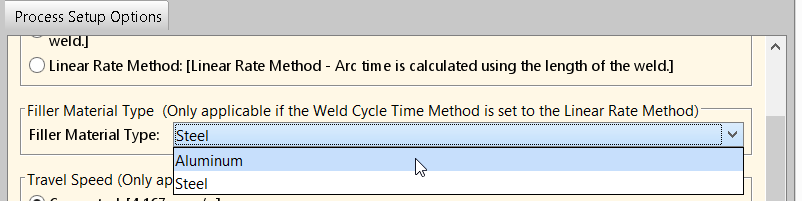
Filler material type affects travel speed, which affects MIG Welding Operation Weld Time for the Linear Rate Weld Cycle Time Method. It also affects MIG Welding Weld Weight and the MIG Welding Expendable Tooling Calculation.
Travel Speed
If the linear rate Weld Cycle Time Method is used, weld time is based, in part, on travel speed. By default, travel speed is derived from Weld Throat and Filler Material Type; see MIG Welding Operation Weld Time. This is the speed (distance per unit time) at which the weld head travels along the length of the weld.
By default, it is looked up in the lookup table tblWeldTravelSpeed by the following:
- Weld Throat for a Canonical Weld that is equivalent to the portion of the weld created in a single pass. This is the throat for a Canonical Weld whose area equals the following: the Weld Cross-sectional Area of the current weld divided by the Number of Welding Passes.
- Gas Type used for Welding
- Filler Material Type
-
Wire Diameter
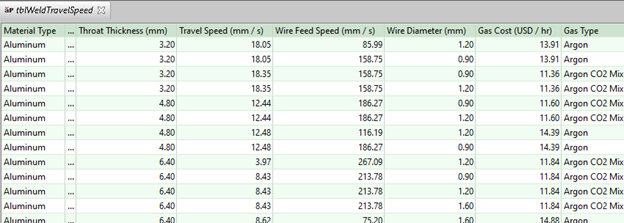
Users can override the default on a per-GCD basis with the setup option Travel Speed.
Number of Welding Passes
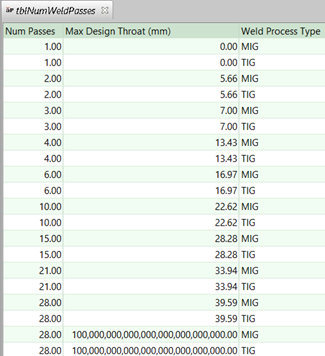
If the linear rate Weld Cycle Time Method is used, weld time is based, in part, on the number of welding passes used for weld (that is, the number of times the weld head traverses the length of the weld). By default, the number of passes is derived from Weld Throat; see MIG Welding Operation Weld Time.
By default, the number of welding passes is looked up in the lookup table tblNumWeldPasses by the following:
- Process type (MIG or TIG)
-
Weld Throat of a Canonical Weld with the same area as the current weld.
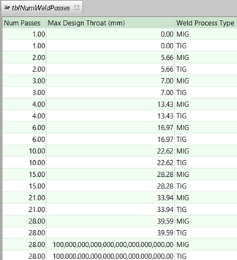
Users can override the default on a per-GCD basis with the setup option Number of Welding Passes.
Gas Type used for Welding
By default, the type of gas used for welding is specified by the cost model variable defaultMigWeldingGasType (Argon in starting point Digital Factories). Users can override the default on per-GCD basis with the setup option Gas Type Used for Welding. Gas type affects gas cost - see Additional Direct Costs for MIG Welding.
Enable Anti-Spatter Spray
By default in starting point Digital Factories, costs for antispatter spray are included in expendable tooling costs; see MIG Welding Expendable Tooling Calculation. Administrators can customize the default, and specify no cost for antisplatter spray, by setting the cost model variable weldAntiSpatterSprayEnabled to false. Users can override the default on a per weld basis with this setup option.
Wire Diameter
By default, wire diameter is the smallest qualified wire diameter that appears in the lookup table tblWeldTravelSpeed. A qualified wire diameter for a given weld is a wire diameter listed in a row that meets the following qualifications:
- Row’s Throat Thickness matches the Weld Throat of a Canonical Weld with the same Weld Cross-sectional Area as the given weld.
- Row’s Gas Type matches the current Gas Type used for Welding.
- Row’s Material Type matches the current Filler Material Type. With the setup option Wire Diameter, users can override the default on a per-GCD basis.
With the setup option Wire Diameter, users can override the default on a per-GCD basis.
Number of Welder Positions
For robotic welding, the cost model accounts for the time for the welder to position itself once per Weld GCD. For manual welding, the cost model estimates the number of welder positions based on the number of weld segments, the segment length, and the machine property Welder Reach--see Manual MIG Welding and Robotic MIG Welding.
With the setup option Number of Welder Positions, the user can override the default on a per-GCD basis. The number of welder positions drives welding cycle time and labor time.